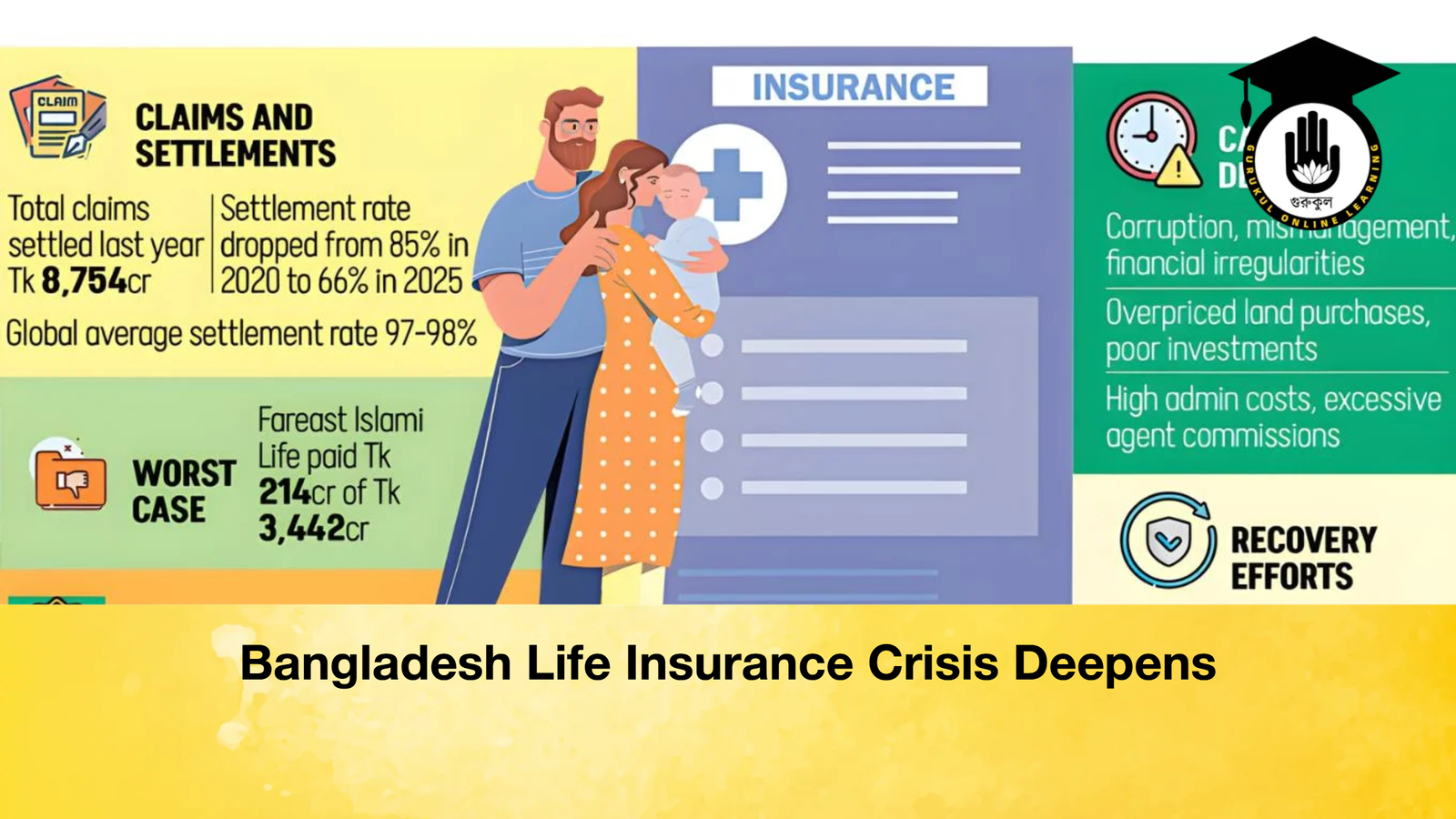
Bangladesh’s life insurance sector is currently grappling with a severe financial and administrative crisis that has significantly eroded public confidence. Long-standing weaknesses in governance, irregularities in investment practices, and allegations of mismanagement have combined to create a mounting backlog of unpaid insurance claims, leaving millions of policyholders in distress.
According to the latest available data, approximately 1.2 million policyholders across the country are currently awaiting settlement of their claims. The total outstanding liability has risen to around BDT 44.03 billion, reflecting a deepening liquidity strain within the sector. This growing backlog has raised serious concerns about the sustainability and credibility of several life insurance companies operating in Bangladesh.
A case in point is that of Monjur Rahman, who purchased a life insurance policy in 2012 to secure his family’s financial future. Upon maturity in 2022, his entitled payout amounted to BDT 1.119 million. Despite submitting all required documentation, he has yet to receive his payment. He further stated that even an application for partial withdrawal, submitted during a period of urgent medical need within his family, was rejected. His experience mirrors that of hundreds of thousands of policyholders facing prolonged delays and uncertainty.
Under existing regulations, insurance providers are required to settle valid claims within 90 days of receiving all necessary documentation. However, industry practice diverges significantly from this legal requirement, with many companies failing to meet deadlines and leaving claims unresolved for years.
Regulatory figures indicate a worrying trend of deterioration. In 2023, outstanding claims affected around 1 million policyholders, totalling approximately BDT 30.5 billion. By 2025, this figure had escalated to 1.2 million policyholders and BDT 44.03 billion. During the same period, the overall claim settlement rate declined sharply from 85 per cent to 66.06 per cent, highlighting a significant weakening in operational efficiency across the sector.
A comparative overview of selected insurance companies illustrates the scale of the problem:
| Insurance Company | Total Claims (BDT crore) | Paid (BDT crore) | Settlement Rate | Policyholders Affected |
|---|---|---|---|---|
| Fareast Islami Life | 3442 | 214 | 6% | 5.66 lakh |
| Padma Islami Life | Limited data | Low | 4% | Significant |
| Progressive Life | Limited data | Low | 21% | Significant |
| Golden Life | Limited data | Low | 11% | Significant |
| Sunflower Life | Limited data | Low | 5.5% | Significant |
| Bayra Life | Limited data | Low | 1.6% | Significant |
| Akij Takaful Life | Fully settled | Full | 100% | None |
| Alpha Islami Life | Fully settled | Full | 100% | None |
Investigations by regulatory authorities have revealed a range of serious concerns, including alleged fund misappropriation, excessive administrative expenditure, weak investment strategies, and irregular asset management practices. In some cases, there have been accusations of inflated land acquisition costs and misuse of bank loans, further aggravating the financial instability of certain firms.
Experts argue that the root causes lie in prolonged structural inefficiencies, poor investment decisions, and declining income generation within many insurers. Some also suggest that deliberate delays in claim settlements may be occurring in order to ease short-term liquidity pressures.
Industry analysts have recommended urgent corrective measures, including the consolidation of financially weak companies, stricter regulatory enforcement, and enhanced transparency in financial reporting. Without comprehensive reform, they warn that the sector risks further deterioration, with increasing public dissatisfaction and heightened financial vulnerability.
Overall, the crisis in Bangladesh’s life insurance industry has evolved beyond a financial imbalance into a profound trust deficit. Unless decisive action is taken, both policyholders and the broader financial system may face escalating risks in the years ahead.