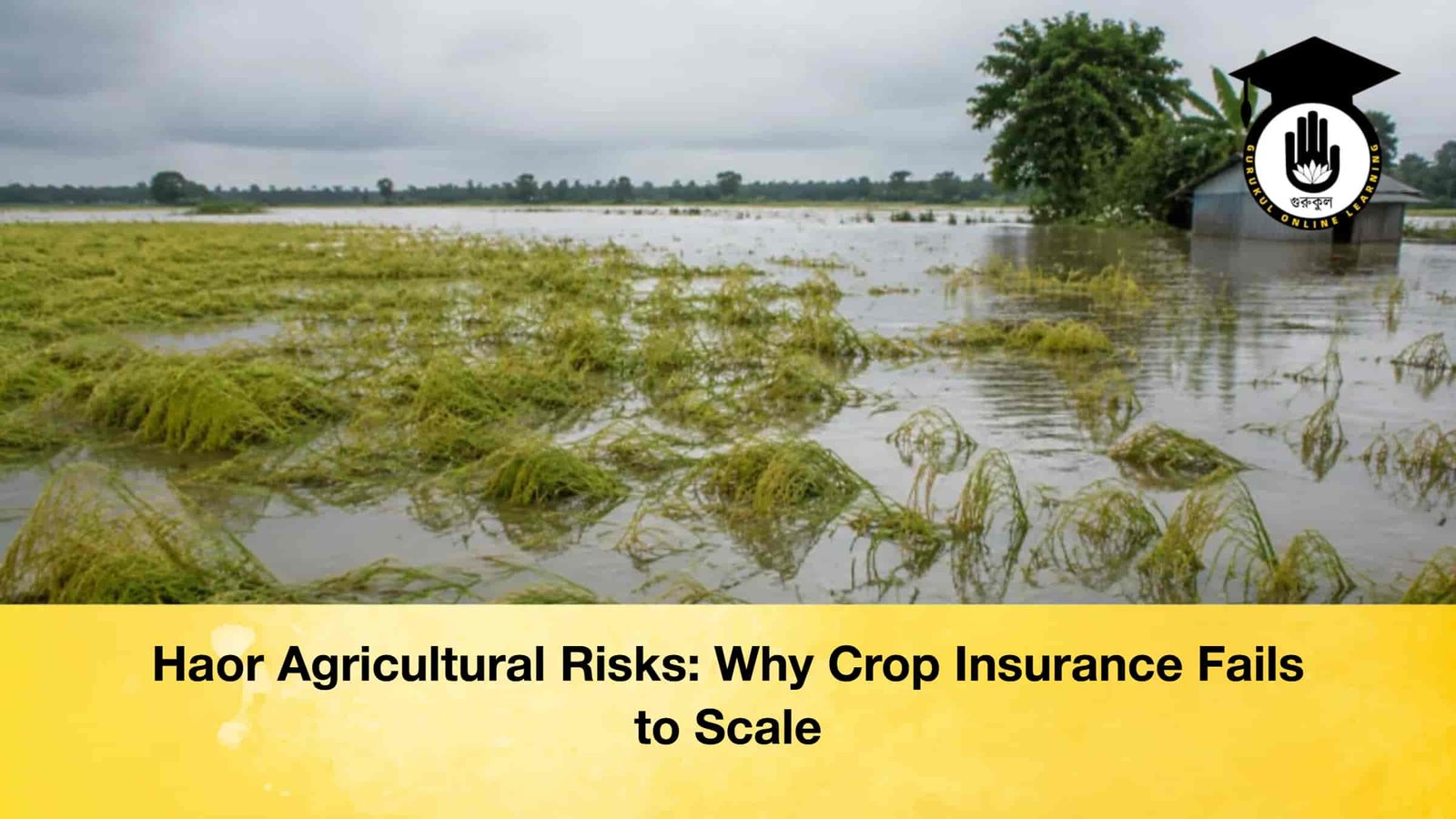
The vast Haor regions of Bangladesh, including Sunamganj, Kishoreganj, Netrokona, and Sylhet, are facing severe agricultural uncertainty as Boro paddy cultivation remains highly vulnerable to climatic extremes. In early May 2026, flash floods, torrential rainfall, and onrushing water from upstream submerged extensive paddy fields. Preliminary estimates indicate that approximately 100,000 hectares of Boro land across seven Haor districts have been damaged, impacting roughly 150,000 farming families.
Scale of Economic Impact
Reports from Sunamganj and Kishoreganj alone suggest that financial losses have exceeded 500 million BDT. According to data from the Department of Agricultural Extension (DAE), cited by Reuters, over 46,000 hectares were submerged in the north-eastern Haor areas, leading to an anticipated production shortfall of more than 200,000 tonnes of Boro paddy.
Despite these recurrent risks, more than 95% of farmers in the Haor region remain outside the coverage of crop insurance. For these families, Boro paddy is the primary source of income; a single failed season can lead to severe debt cycles and an inability to meet basic educational and daily expenses.
| Parameter | Estimated Figures (2026) |
| Total Affected Land | ~100,000 Hectares |
| Production Deficit | >200,000 Tonnes |
| Affected Families | ~150,000 |
| Insurance Coverage | <5% of Farmers |
| Loss (Sunamganj & Kishoreganj) | >500 Million BDT |
Barriers to Insurance Adoption
While weather index-based crop insurance (WIBCI) pilot projects have been introduced by entities such as Green Delta Insurance and Pragati Insurance, several factors hinder large-scale adoption:
-
Lack of Awareness: Many smallholders harbour misconceptions regarding insurance, fearing that claiming compensation will be a bureaucratic and futile process.
-
Trust Deficits: Farmers require immediate liquidity following a disaster. Although satellite and ground-station data are used to trigger payouts in WIBCI, discrepancies between remote sensing data and actual field conditions often lead to disputes.
-
High Premiums: Due to the high risk of the region, premiums remain costly, typically ranging between 5% and 8% of the insured sum. For an acre of land valued at 12,000 BDT, a premium of 600 to 900 BDT is often prohibitive for impoverished farmers already burdened by input costs.
-
Land Ownership Issues: A significant portion of Haor cultivators are sharecroppers or landless farmers. Traditional insurance often requires ownership documentation, effectively excluding the most vulnerable producers.
Historical Context and Government Response
The vulnerability of the region is evident in the records of the past five years. Following catastrophic floods in 2022, the region faced sudden onrushes of water in 2023. While 2024 and 2025 saw relatively minor losses, the 2026 floods have once again highlighted the systemic risk.
In response to the current crisis, the Ministry of Agriculture has announced a financial aid package, offering affected farmers a monthly stipend of 7,500 BDT in the initial phase. Concurrently, a long-term project worth 1.429 billion BDT has been initiated to excavate rivers and canals in Netrokona and Sunamganj, scheduled for completion by 2029.
Path Forward
Experts contend that structural measures like embankments are insufficient against the backdrop of climate change. A sustainable solution necessitates a public-private partnership involving the government, insurers, and NGOs to provide subsidised premiums and mobile-based claim settlements. Ensuring the inclusion of sharecroppers and fostering grassroots awareness are essential to transforming crop insurance into a viable safety net for Haor’s agricultural economy.