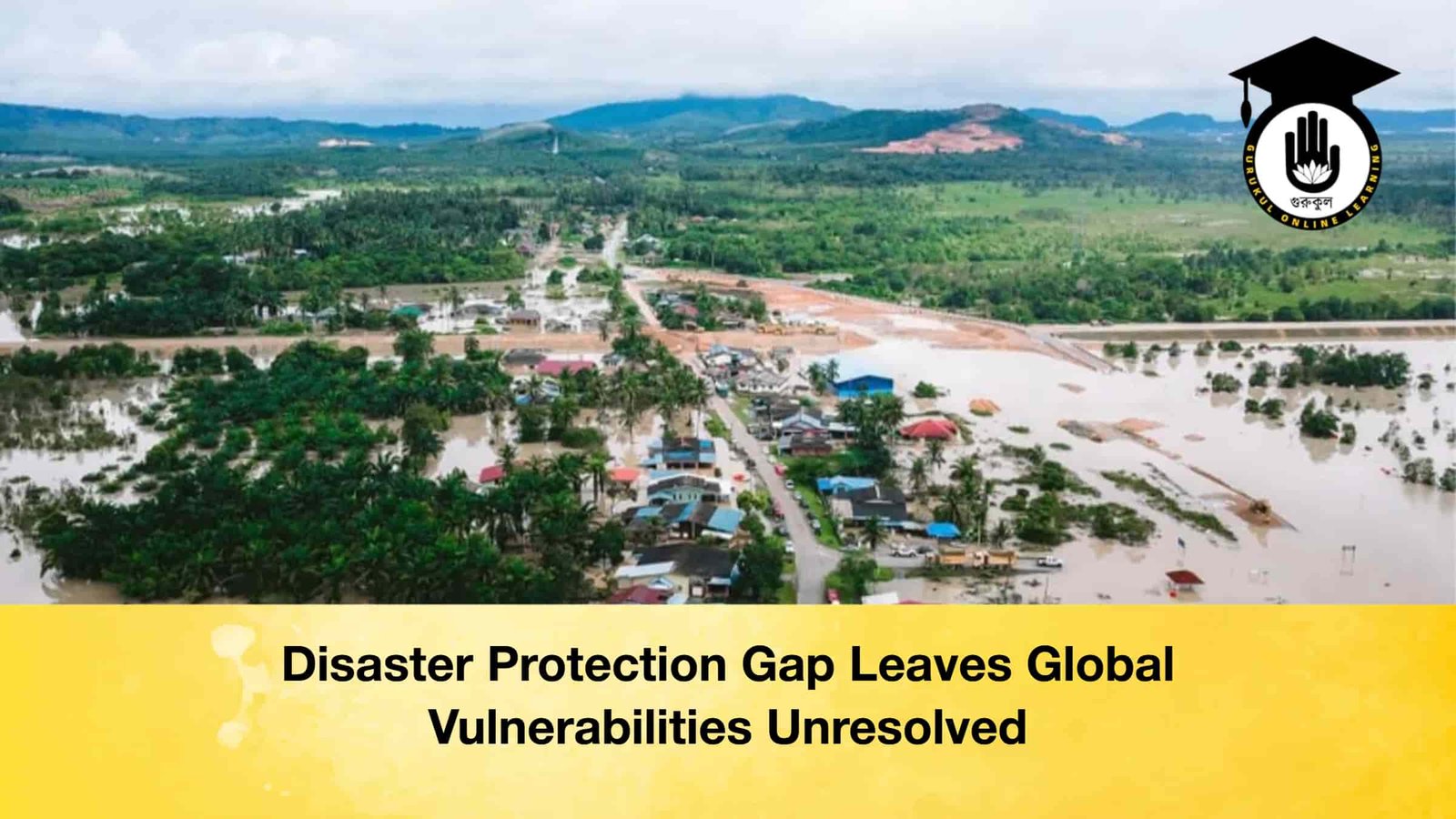
Uninsured Financial Burdens in the Asia-Pacific Region
The escalating frequency and severity of natural disasters are driving steep financial losses globally. Data released by the Swiss Re Institute reveals that approximately 88 per cent of all calamity-related financial losses in the Asia-Pacific region remain entirely unprotected by insurance. Concurrently, the global insurance protection gap—defined as the shortfall between total economic losses and insured values—has widened to 424 billion USD. Analysts observe that this disparity places an immense fiscal burden directly onto citizens, private businesses, and sovereign governments, serving as a critical warning for climate-vulnerable countries such as Bangladesh.
Global Natural Catastrophe Metrics
According to an analysis conducted by the Swiss Re Institute for the year 2025, approximately 190 natural catastrophes occurred across the globe, generating an estimated 220 billion USD in total economic damage. Out of this aggregate figure, insured losses accounted for 107 billion USD, meaning more than half of the global financial devastation lacked any insurance indemnity.
Developing and emerging market economies remain disproportionately exposed to these unprotected losses, where between 80 and 90 per cent of all natural disaster destruction occurs completely outside the scope of insurance coverage. Consequently, the funding required for post-disaster reconstruction, rehabilitation, and emergency humanitarian relief must be raised almost entirely by domestic populations and state exchequers.
Asia-Pacific and North American Risks
Within the Asia-Pacific region, the insurance protection gap stands at roughly 88 per cent, meaning that for every 100 USD of economic damage incurred, a mere 12 USD is recovered via insurance claims. This systemic vulnerability affects highly disaster-prone nations across the territory, including Bangladesh, Myanmar, the Philippines, Indonesia, Pakistan, and numerous Pacific island states.
Conversely, in terms of absolute financial volume, North America was identified as the most heavily impacted territory. Severe convective storms, wildfires, and related weather anomalies across the United States generated massive insured and uninsured liabilities. Even though insurance penetration remains comparatively high in North America, the scale of destruction establishes it as a primary focal point of global catastrophe risk.
The severe earthquake that struck Myanmar in 2025 serves as a clear illustration of this regional protection gap. The seismic event caused approximately 11 billion USD in total economic losses alongside extensive casualties. However, the insurance sector disbursed just over 200 million USD in compensation, leaving the government of Myanmar, international aid agencies, and the affected population to finance the remainder of the reconstruction costs.
The Prominence of Secondary Perils
Climatological analyses indicate that the risks associated with climate change are intensifying rapidly. Beyond typical major hazards like cyclones and river floods, there is a distinct rise in localized occurrences such as wildfires, severe thunderstorms, flash flooding, torrential rainfall, and prolonged heatwaves. In 2025, an unprecedented 92 per cent of global insured losses were caused by “secondary perils”—which encompass storms, wildfires, hailstorms, and similar localized weather events—marking the highest proportion attributed to these specific hazards on record.
| Regional and Global Catastrophe Indicators (2025) | Financial Value / Percentage Metric |
| Global Economic Losses from Catastrophes | 220 billion USD |
| Global Insured Catastrophe Losses | 107 billion USD |
| Global Insurance Protection Gap | 424 billion USD |
| Asia-Pacific Insurance Protection Gap | ~88% of local losses |
| Emerging Economies Protection Gap Range | 80% to 90% of local losses |
| Share of Losses from Secondary Perils | 92% of global insured losses |
| Myanmar Earthquake Economic Damage | 11 billion USD |
| Myanmar Earthquake Insured Payout | ~200 million USD |
| Projected Global Insured Losses by 2030 | 186 billion USD |
Localized Vulnerabilities and Fiscal Strain
Industry experts emphasize that these findings represent a stark warning for Bangladesh. The country’s vast coastal zones, erosion-prone riverbanks, agricultural sectors, and low-income demographics are facing heightened exposure to climate hazards. Although cyclones, floods, tidal surges, riverbank erosion, and lightning strikes cause severe annual losses, the deployment of catastrophe-specific insurance instruments in Bangladesh remains very limited.
Following major disasters, the Government of Bangladesh faces significant fiscal strain. Substantial public funds are required immediately to repair disrupted roads, bridges, embankments, and electricity grids, alongside financing rehabilitation, food distribution, medical assistance, and emergency relief operations. Revitalising the agricultural sector and supporting small businesses requires further public expenditure, often forcing the state to reallocate capital away from long-term national development projects, which can slow broader economic growth.
Parametric Insurance as a Strategic Solution
To mitigate these systemic financial exposures, parametric insurance is increasingly viewed as a viable solution. Unlike traditional indemnity insurance, which involves lengthy damage assessment processes, parametric frameworks trigger automatic disbursements as soon as pre-defined, objective indices are breached. Payouts can be tied directly to measurable parameters, such as specific millimetres of rainfall, maximum wind speeds during a cyclone, or river height measurements during a flood event. This mechanism facilitates rapid capital injection to affected individuals and commercial entities, speeding up recovery efforts.
Sector analysts indicate that Bangladesh possesses substantial scope for the deployment of agricultural, flood, and cyclone-based parametric insurance policies. However, scaling up these mechanisms requires access to accurate meteorological datasets, technology-driven risk assessments, and supportive legislative frameworks.
Because the scale of this challenge exceeds the capacity of private insurance firms alone, experts stress the necessity of forming public-private partnerships (PPPs) involving the government, the local insurance industry, international development partners, and global reinsurance syndicates. These collaborative partnerships are deemed essential for lowering premium costs, sharing high-level risks, providing technological assistance, and building long-term climate resilience. Swiss Re forecasts that if current trends continue without proactive risk mitigation and wider insurance adoption, global insured losses could climb to 186 billion USD by the year 2030.