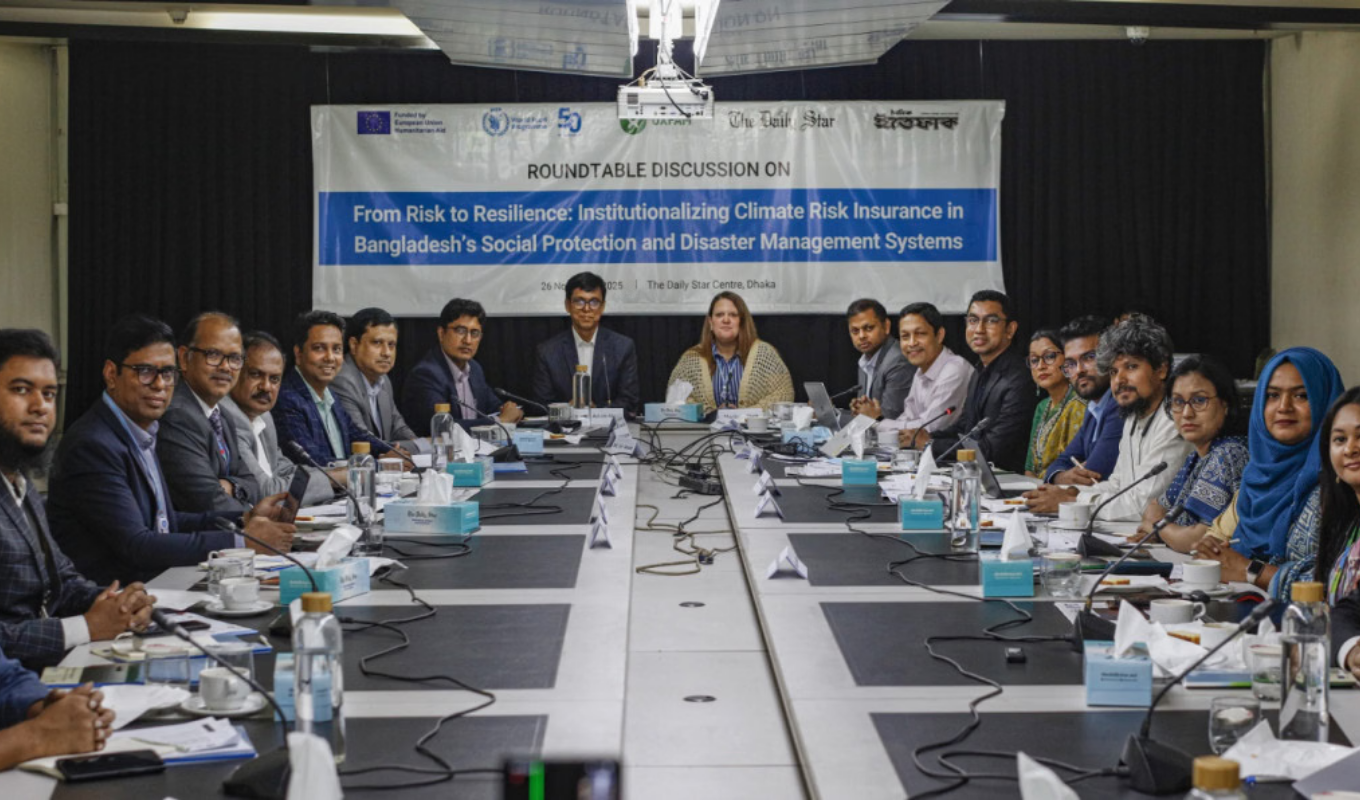
The government must remove existing barriers and implement policies to introduce climate risk insurance (CRI) products, encouraging private insurance companies to enter the market, experts urged at an event today.
The event, titled “From Risk to Resilience: Institutionalising Climate Risk Insurance into Bangladesh’s Social Protection and Disaster Management Systems,” was jointly organised by the World Food Programme (WFP), Oxfam, and The Daily Star at The Daily Star Centre in Dhaka.
Experts recommended that the government consider offering value-added tax (VAT) exemptions for micro-insurance, revising commission ceilings, and developing a targeted premium subsidy framework based on vulnerability and climate exposure.
Professor Suborna Barua, Chairman of the Department of International Business at the University of Dhaka, said, “Opening reinsurance markets to more private or foreign firms will provide greater choice for insurance companies, improve service quality, reduce costs, and increase efficiency, particularly for CRI.” He added, “The government should formally recognise climate and disaster risk insurance in national plans and policies, offering fiscal incentives like VAT exemptions. Better coordination among ministries is crucial to accelerate CRI adoption.”
Bangladesh is one of the most climate-exposed countries in the world, frequently affected by floods, cyclones, storm surges, and erratic rainfall, which threaten livelihoods, food security, and rural incomes. For millions of smallholder farmers and vulnerable households, a single climate event can wipe out an entire season’s income, pushing them deeper into debt and poverty.
Maribeth Black, Deputy Head of Programme at WFP, said, “WFP is working closely with Bangladesh to design and test climate insurance products and review existing policies and legislation to integrate CRI guidelines into future response mechanisms.”
Tarik Ur Rahman, a consultant at Green Delta Insurance, stated, “With rising climate risks, GDI’s scalable, tech-driven, and farmer-centric model is ready for national and global replication, providing vulnerable communities with the confidence to face an uncertain future.”
Mohammad Emran Hasan, Head of Climate Justice and Natural Resource Rights at Oxfam Bangladesh, emphasised the importance of carefully introducing new insurance products into the market by both the government and private actors.
Imanun Nabi Khan, Assistant Country Representative at FAO Bangladesh, highlighted, “Loss and damage are inevitable and must be accurately measured. During last year’s floods, even households receiving remittances lacked basic resources and struggled to communicate with family members abroad. This shows that money alone is not enough—precise data and technology are essential.”
Md Najmul Alam, Deputy Secretary at the Ministry of Planning, urged development partners to work with the government to help cover part of farmers’ insurance premiums, noting that the government already provides extensive subsidies.
M Aslam Alam, Chairman of the Insurance Development and Regulatory Authority, remarked, “The current insurance law does not cover parametric insurance, but the proposed amendment to the Insurance Act includes it. Once approved, this will remove the legal barrier.”
Muhammad Tanjim Ferdous, in charge of NGO and foreign missions at The Daily Star, moderated the event.
| Information | Details |
|---|---|
| Event Title | From Risk to Resilience |
| Organisers | World Food Programme, Oxfam, The Daily Star |
| Key Recommendation | Introduce climate risk insurance and remove market barriers |
| VAT Exemption Proposal | For micro-insurance products |
| Farmers’ Insurance Premium Subsidy | Suggested by government and development partners |
| Proposed Legal Amendment | Insurance Act to cover parametric insurance |
| Event Moderator | Muhammad Tanjim Ferdous, The Daily Star |