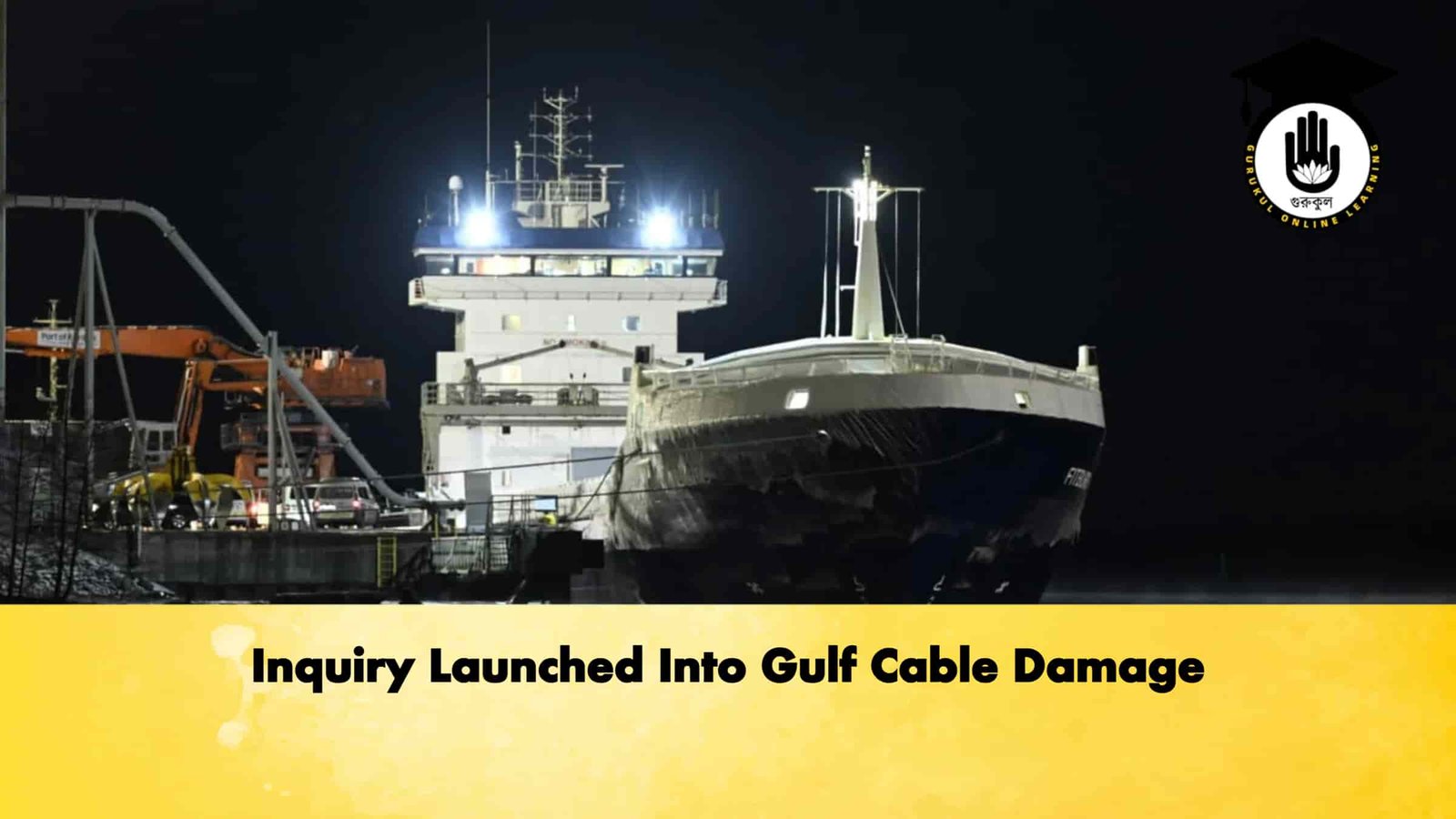
Authorities in Finland and Estonia have opened a wide-ranging investigation after damage was discovered to a critical undersea telecommunications cable in the Gulf of Finland, a strategically sensitive stretch of water linking the Nordic and Baltic states. The incident was detected in the early hours of Wednesday along a cable route connecting Helsinki and Tallinn, prompting immediate maritime and criminal inquiries on both sides of the Gulf.
Finnish border guards confirmed that they seized and inspected a merchant vessel suspected of causing the damage after it was found within Finland’s exclusive economic zone with its anchor lowered. According to officials, the ship had been dragging its anchor for several hours, raising suspicions that it may have struck subsea infrastructure. Helsinki police subsequently opened an investigation into aggravated criminal damage, attempted aggravated criminal damage, and aggravated interference with telecommunications.
The damaged cable is owned by Elisa, one of Finland’s largest telecommunications providers, and is classified as critical underwater infrastructure. Although the physical damage occurred within Estonia’s exclusive economic zone, Finnish and Estonian authorities are coordinating closely, reflecting the cross-border nature of the network. Elisa stated that, despite the incident, customer services were not disrupted.
The vessel under scrutiny, the Fitburg, is registered in St. Vincent and the Grenadines and was travelling from Russia to Israel. Finnish media reported that its 14-member crew — nationals of Russia, Georgia, Azerbaijan and Kazakhstan — were detained for questioning. Finnish National Police Commissioner Ilkka Koskimäki stressed that investigators were not, at this stage, speculating on the involvement of any state actor.
President Alexander Stubb sought to reassure the public, noting that Finland remains alert to a wide spectrum of security threats and is prepared to respond decisively when critical infrastructure is endangered.
The Gulf of Finland and the wider Baltic Sea host a dense network of undersea cables and pipelines that support electricity transmission, digital connectivity, trade and energy security across northern and central Europe. These links have taken on heightened geopolitical importance since Russia’s full-scale invasion of Ukraine in 2022, particularly as European states work to reduce dependence on Russian energy.
The latest incident follows a series of similar cases. Earlier this year, Finnish prosecutors charged the captain and two senior officers of the oil tanker Eagle S over damage to cables between Finland and Estonia on Christmas Day 2024. That vessel was later described by Finnish and EU officials as part of Russia’s so-called “shadow fleet” — ageing tankers operating under obscure ownership structures to circumvent Western sanctions. Moscow has consistently denied involvement in such incidents.
Estonian authorities are now considering whether to pursue a separate criminal case or proceed jointly with Finland over the Elisa cable. Complicating matters further, Estonia confirmed that another undersea cable, owned by Swedish operator Arelion, was also damaged on Wednesday, while a separate Sweden–Estonia cable suffered damage a day earlier. Arelion said repair work would begin once weather conditions improve and that most customers remain unaffected.
Recent Undersea Cable Incidents in the Baltic Region
| Date | Cable Owner | Location | Suspected Vessel | Service Impact |
|---|---|---|---|---|
| Wednesday | Elisa (Finland) | Gulf of Finland (EEZ of Estonia) | Fitburg | No disruption |
| Tuesday–Wednesday | Arelion (Sweden) | Gulf of Finland / Baltic Sea | Under investigation | Minimal |
| Dec 25, 2024 | Multiple operators | Finland–Estonia route | Eagle S | Localised impact |
As investigations continue, European authorities face mounting pressure to enhance the protection and monitoring of the undersea networks that underpin the region’s economic and security architecture.