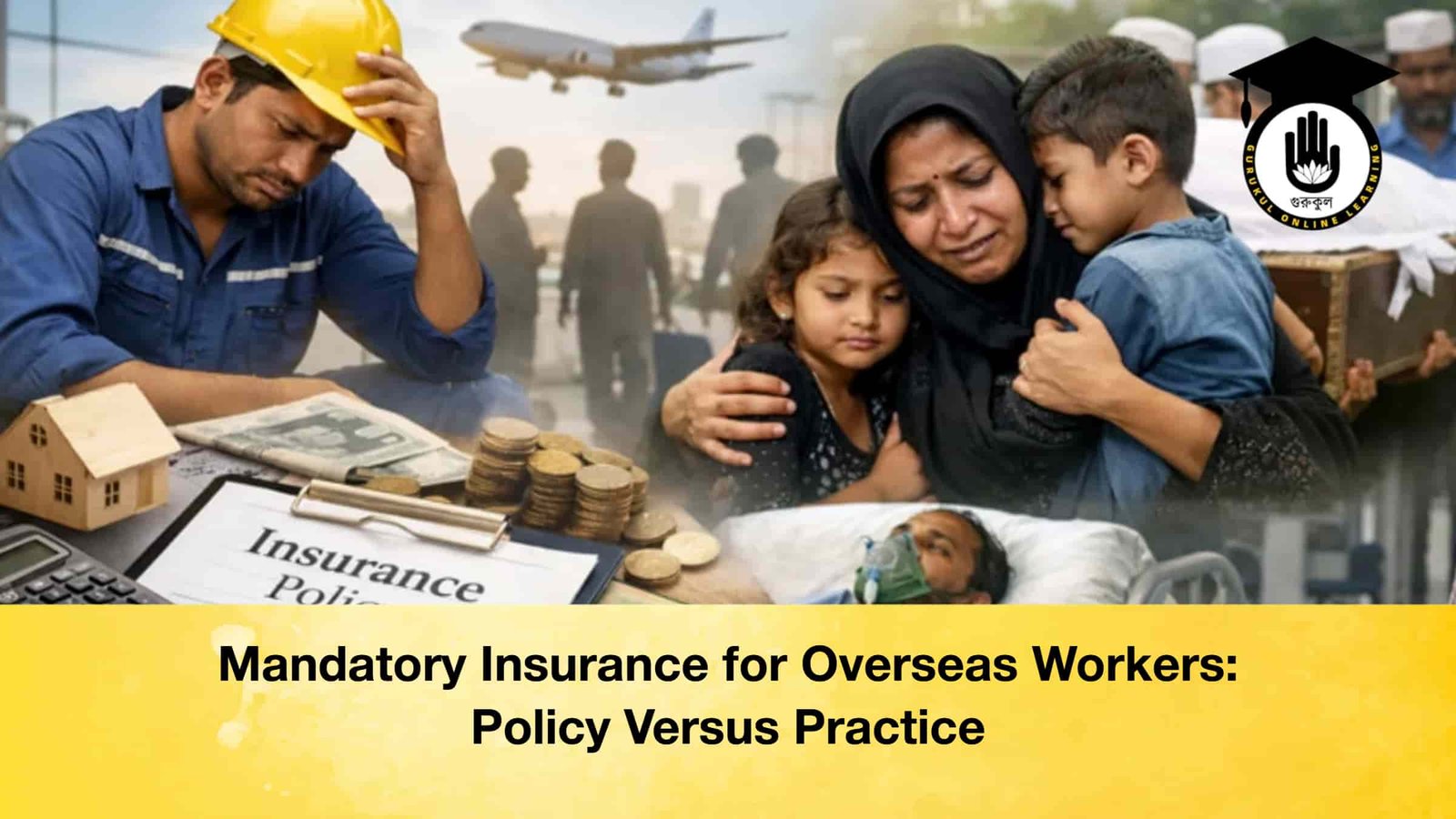
Although Bangladesh has instituted mandatory insurance for its overseas workers, significant gaps persist between policy intentions and real-world outcomes. While the regulations promise financial protection on paper, many migrant workers and their families continue to be deprived of the support they are entitled to.
Background of the Policy
Since 2019, it has been compulsory for workers departing Bangladesh for employment abroad to enrol in an insurance scheme. In December 2022, the government revised the policy, increasing coverage to a maximum of 10 lakh taka per worker.
The insurance is activated upon payment of a premium of 1,000 taka at the time of departure and remains valid for five years. Premium collection is handled by the Wage Earners’ Welfare Board, while claims are disbursed through the Life Insurance Corporation.
Coverage Details
The policy provides financial compensation in the following scenarios:
| Benefit Type | Coverage Amount | Conditions |
|---|---|---|
| Death | Up to 10 lakh taka | If the worker dies abroad or within a specified period after returning |
| Permanent Total Disability | Up to 10 lakh taka | Loss of both eyes, both hands, or both legs |
| Partial Disability | 1–5 lakh taka | Based on the degree of disability |
| Job Loss Abroad | Up to 50,000 taka | If employment is lost within six months for valid reasons |
Challenges in Implementation
Despite the policy’s comprehensiveness, implementation has proven problematic. Claims are often denied if the death is classified as suicide, and workers returning home due to serious illness may also fall outside coverage. Pre-existing medical conditions prior to policy acceptance are not eligible for compensation.
A significant issue is the lack of awareness. Many workers are unaware of their insurance enrolment or the claim procedure, making it difficult for families to gather the required documentation. Collecting proof from overseas adds further complexity.
Exploiting these difficulties, fraudulent intermediaries have emerged, demanding high commissions to “facilitate” insurance claims. Consequently, genuine beneficiaries are doubly disadvantaged—both financially and procedurally.
Expert Recommendations
Analysts stress that while the insurance scheme is vital for migrant worker welfare, its effectiveness depends on increased awareness, simplification of the claims process, and strict regulation to curb intermediary exploitation. Without these measures, the gap between policy and practice is likely to persist, leaving vulnerable workers and their families exposed.