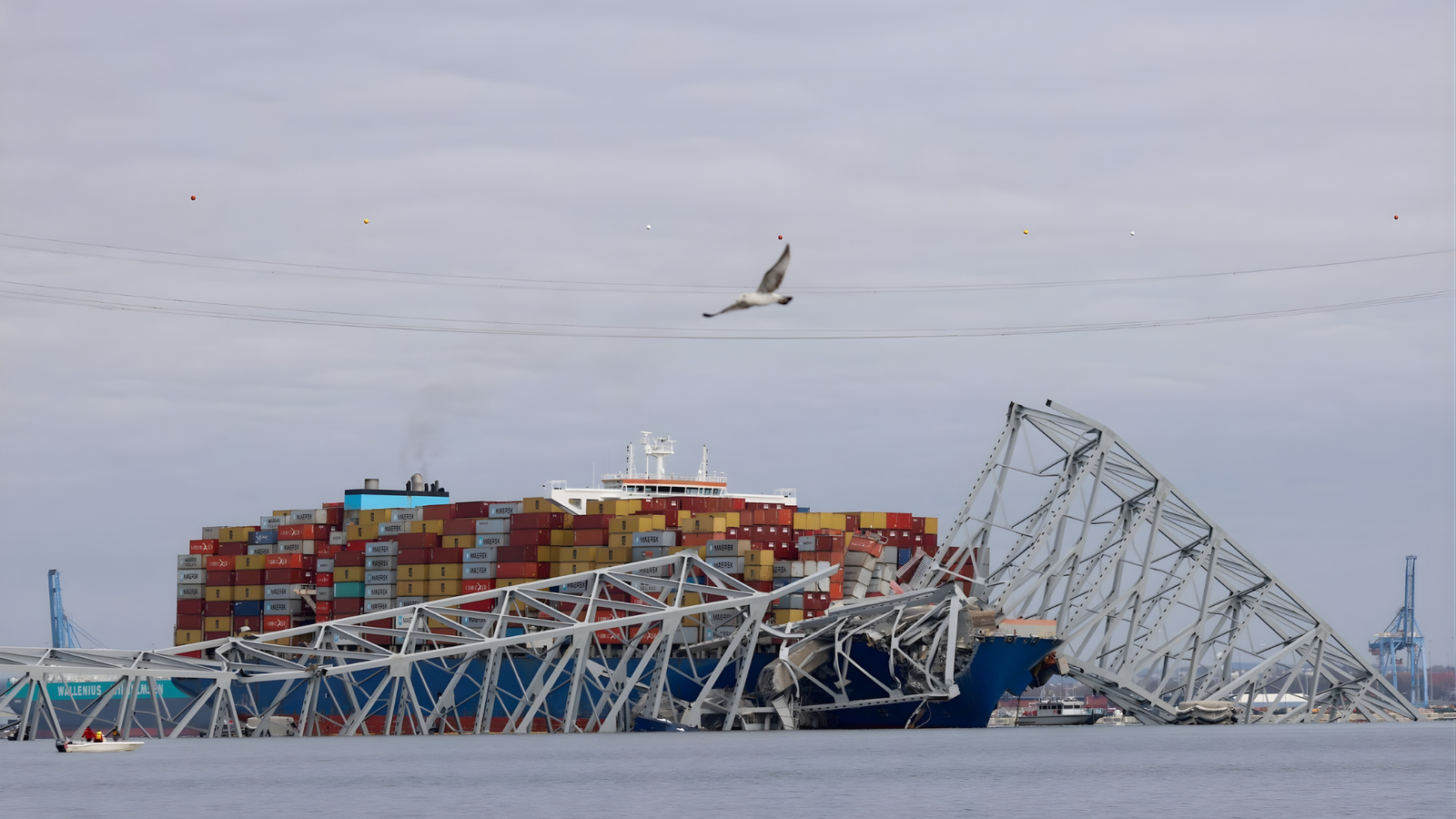
The National Transportation Safety Board (NTSB) is preparing to reveal its long-awaited conclusions on the catastrophic collapse of Baltimore’s Francis Scott Key Bridge. The agency will hold a public board meeting on Tuesday, 18 November, at 9:30 a.m. ET at its Boardroom and Conference Centre in Washington, DC, where officials will vote on the investigation findings, the probable cause of the disaster, and any additional safety recommendations.
The event marks a major milestone in one of the most significant infrastructure-related investigations in recent US history. On 26 March 2024, the containership Dali was departing Baltimore Harbour when it suddenly lost electrical power and propulsion. With its systems disabled moments before reaching the bridge—just three ship lengths away—the vessel drifted off course and struck the southern pier supporting the central truss spans of the Key Bridge. The impact caused a catastrophic, near-instantaneous collapse.
The tragedy claimed the lives of six construction workers who were carrying out maintenance on the bridge at the time. Another worker was critically injured, while one crewmember aboard the Dali sustained injuries. The disaster shocked the nation, prompting urgent discussions about infrastructure resilience and maritime safety.
The NTSB’s public docket, released earlier, contains technical reports, interview transcripts, and extensive investigative documents. Preliminary findings revealed that electrical breakers on the Dali unexpectedly tripped, cutting off power to essential shipboard systems—including the cooling pumps for the main engine—triggering an automatic shutdown of the propulsion system. With no engine power and no propeller movement, the crew had limited ability to control the vessel’s direction.
Beyond the immediate cause of the collision, the incident raised broader concerns about the vulnerability of ageing bridges across the United States. Following the collapse, the NTSB conducted a national vulnerability assessment and discovered that the Key Bridge exceeded the acceptable risk threshold for critical bridges by nearly 30 times, based on standards from the American Association of State Highway and Transportation Officials (AASHTO).
The investigation further identified 68 similar bridges in 19 states that were designed before the current AASHTO guidelines existed and therefore lacked modern vulnerability assessments. The NTSB called for urgent evaluation of these bridges to determine the risk posed by potential vessel impacts.
Maryland state officials, however, faced criticism from the NTSB for failing to conduct a risk assessment on the Key Bridge in the years prior to its collapse. State authorities maintained that responsibility lay solely with the Dali and its operators.
Nearly one year after the tragedy, Maryland unveiled the design for a new, more resilient Key Bridge. The replacement structure will be taller, equipped with stronger protective systems, and engineered specifically to withstand large-vessel collisions. The state aims to complete construction by October 2028 at an estimated cost of $2 billion.