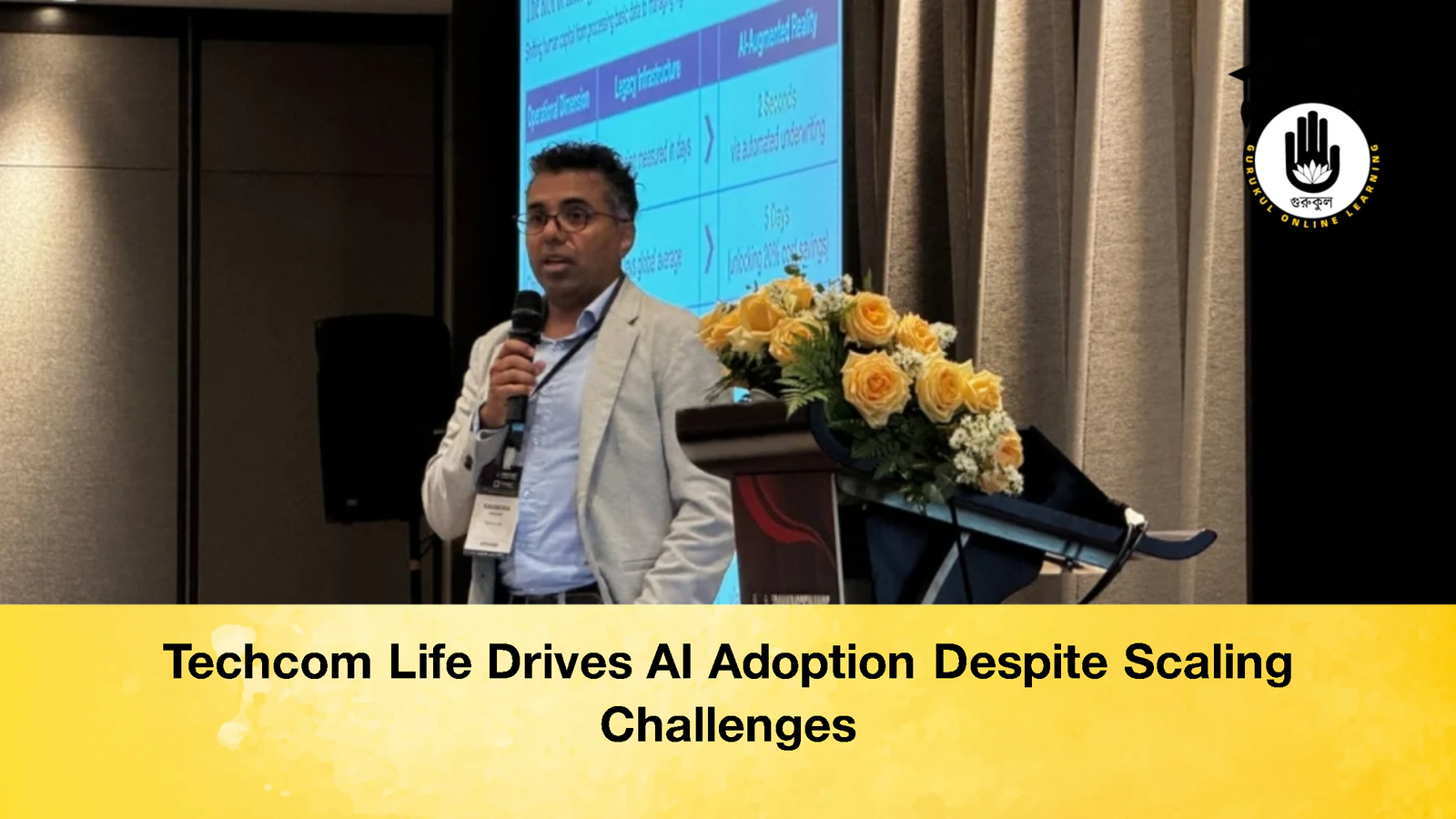
Vietnam’s Techcom Life Insurance Company Limited is intensifying its push towards an artificial intelligence-led business model, seeking to address a persistent industry-wide limitation in which only a minority of AI initiatives progress from pilot phases to full-scale implementation.
Speaking at the Asian Banking & Finance and Insurance Asia Summit in Ho Chi Minh City, Ravindra Venisetti underscored the scale of the challenge. Despite increasing global investment and a surge in experimentation, he noted that fewer than 10% to 15% of AI applications within the insurance sector are successfully deployed at enterprise level. This shortfall, he argued, reflects execution bottlenecks rather than a lack of technological capability.
Against this backdrop, Techcom Life is positioning itself as an “AI-native” insurer. Established only recently, the firm has rapidly integrated AI across its operations, aiming to build a lean and scalable organisation driven by automation and data intelligence rather than workforce expansion. The strategy marks a deliberate departure from traditional insurance models, which typically rely on large agent networks and manual processes.
A central feature of this transformation is the company’s proprietary AI assistant, “Tori”. The platform is already being used by approximately 85% of the firm’s 1,500 agents, providing real-time prompts and insights during customer interactions. By enhancing decision-making at the point of sale, Tori is helping to improve productivity, consistency, and customer engagement. Its widespread adoption illustrates how AI is evolving from a back-office support tool into a frontline driver of business performance.
The broader Vietnamese market offers significant growth potential for such innovation. With insurance penetration standing at around 2%, the country remains well below the levels seen in more developed economies. This gap presents an opportunity for technology-led insurers to expand access and reshape distribution models through digital channels and AI-powered services.
Venisetti highlighted that emerging insurers in Southeast Asia benefit from a structural advantage: the absence of legacy systems. In contrast to long-established firms burdened by outdated infrastructure and fragmented data, newer entrants like Techcom Life can build cloud-native platforms designed for seamless AI integration. This enables faster deployment, greater flexibility, and more efficient scaling of new technologies.
Global research supports the transformative potential of AI in insurance. According to McKinsey & Company, AI-driven underwriting and claims automation could reduce operating costs by up to 40%, whilst improving loss ratios by three to five percentage points. Meanwhile, Deloitte estimates that global investment in insurance AI exceeded $10 billion in 2024, with Asia-Pacific playing an increasingly prominent role.
Within Techcom Life, AI is being embedded into core insurance functions, particularly pricing, underwriting, and claims management. Pricing, traditionally reliant on static actuarial assumptions and spreadsheet models, is being transformed through dynamic algorithms capable of real-time risk evaluation. This shift is expected to deliver more accurate pricing and improved responsiveness to changing customer and market conditions.
Fraud detection is another area of focus. Across Southeast Asia, fraudulent claims are estimated to account for between 10% and 20% of total claims. While AI cannot fully eradicate fraud, it significantly enhances detection through advanced analytics and pattern recognition, enabling earlier intervention and reduced financial losses.
Operationally, the company is also experimenting with high levels of automation. Venisetti revealed that an AI-powered document management system was recently developed and deployed within just three days, without human coding. In addition, AI-driven agents are already functioning as virtual employees, supporting administrative tasks and even collaborating on software development.
Key Metrics in Techcom Life’s AI Transformation
| Area | Details |
|---|---|
| AI Adoption Rate | 85% of 1,500 agents using “Tori” |
| Industry Scaling Rate | Only 10%–15% of AI use cases reach enterprise deployment |
| Insurance Penetration (Vietnam) | Approximately 2% |
| Fraudulent Claims Estimate | 10%–20% of claims in Southeast Asia |
| Cost Reduction Potential | Up to 40% through AI automation (McKinsey) |
| Global AI Investment | Over $10 billion in 2024 (Deloitte) |
Despite these advances, Venisetti acknowledged that the principal constraint is now prioritisation rather than innovation. With numerous AI initiatives emerging simultaneously, selecting which projects to scale first has become increasingly challenging.
He emphasised that disciplined execution and clear strategic focus will be critical to long-term success. As competition intensifies across Southeast Asia’s insurance landscape, Techcom Life’s AI-first approach may serve as a model for how new entrants can leapfrog legacy limitations, accelerate digital transformation, and redefine efficiency in the insurance industry.