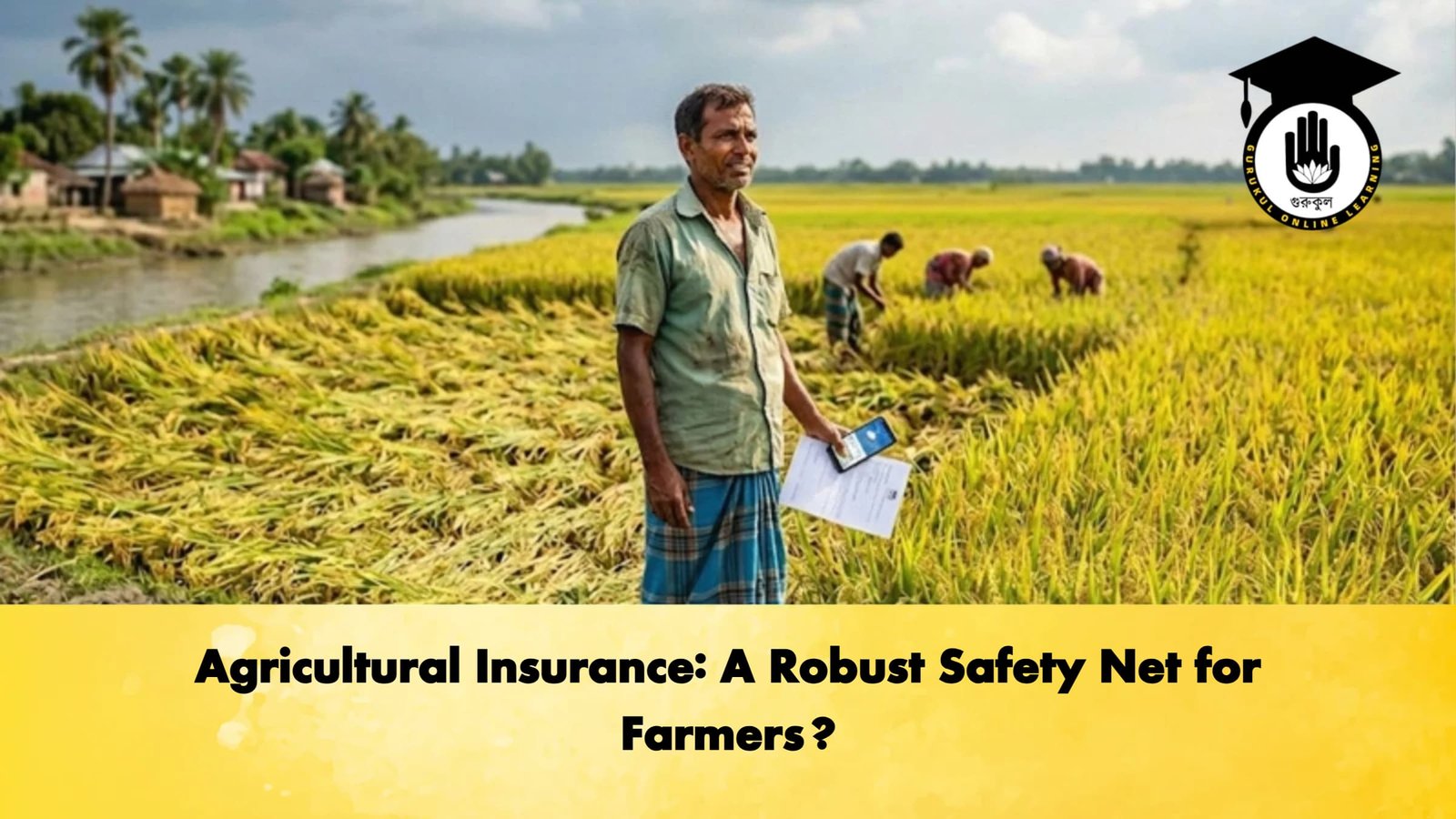
Every year, the relentless cycle of floods, droughts, erratic rainfall, and cyclones devastates the livelihoods of thousands of Bangladeshi farmers. For many, agriculture is a gamble funded by high-interest loans from banks or NGOs. When natural disasters strike, the crops are washed away, yet the burden of debt remains immovable. In this precarious reality, a critical question emerges: does an institutional safety net exist for the tiller of the soil? Can agricultural insurance finally evolve into a dependable shield against climate volatility?
From Pilot Schemes to National Infrastructure
Agricultural insurance is no longer a mere theoretical concept in Bangladesh. Over the past decade, several weather-index-based crop insurance (WICI) pilot projects have been implemented through partnerships between the Shadharan Bima Corporation (SBC) and international development agencies. Private insurers have also dipped their toes into livestock and crop coverage.
While these experiments proved that indemnity payouts are possible, the primary hurdle remains scale. Currently, insurance benefits are confined to specific project zones, leaving the vast majority of marginal and smallholder farmers exposed to total financial ruin.
The Mechanics of Risk Mitigation
The primary appeal of index-based insurance lies in its automated “payout” trigger. Instead of lengthy, bureaucratic field assessments to prove crop loss, compensation is released when weather parameters—such as rainfall levels or temperature thresholds—cross a pre-defined limit.
Key Features and Challenges of Agricultural Insurance:
| Feature | Advantage | Potential Drawback |
| Index-Based Triggers | Rapid payouts without field visits. | Basis Risk: Actual loss may not match the sensor data. |
| Digital Integration | Transparent data tracking via satellites. | High initial cost for weather station infrastructure. |
| Risk Distribution | Shifts the burden from the farmer to the insurer. | Premium Costs: Often unaffordable for marginal farmers. |
| Credit Linkage | Insurance can be bundled with agri-loans. | Requires complex coordination between banks and insurers. |
The Subsidy Conundrum
In most developed agrarian economies, agricultural insurance is heavily subsidised by the state. In Bangladesh, a sustainable, long-term subsidy framework has yet to be formalised. Without government intervention to offset premium costs, these initiatives remain temporary projects rather than permanent national safety nets. For a marginal farmer, choosing between buying fertiliser and paying an insurance premium is a non-starter; the state must bridge this gap to ensure participation.
The Path Towards Resilience
To transform agricultural insurance from a niche experiment into a national pillar of resilience, four strategic shifts are required:
-
Direct Subsidies: The government must provide partial premium support to make policies accessible to low-income farmers.
-
Digital Data Infrastructure: Expanding the network of automated weather stations to ensure granular and indisputable climate data.
-
Institutional Synergy: Leveraging the vast networks of microfinance institutions (MFIs) and the Department of Agricultural Extension (DAE) for distribution.
-
Trust Building: Ensuring transparent, time-bound claim settlements to overcome the historical skepticism farmers hold toward financial institutions.
Ultimately, for a country on the front lines of the climate crisis, agricultural insurance cannot remain a peripheral luxury. It is a fundamental necessity. If backed by robust policy and technological investment, it will cease to be a “pilot project” and become the vital safety net that keeps the nation’s food security—and its farmers—afloat.