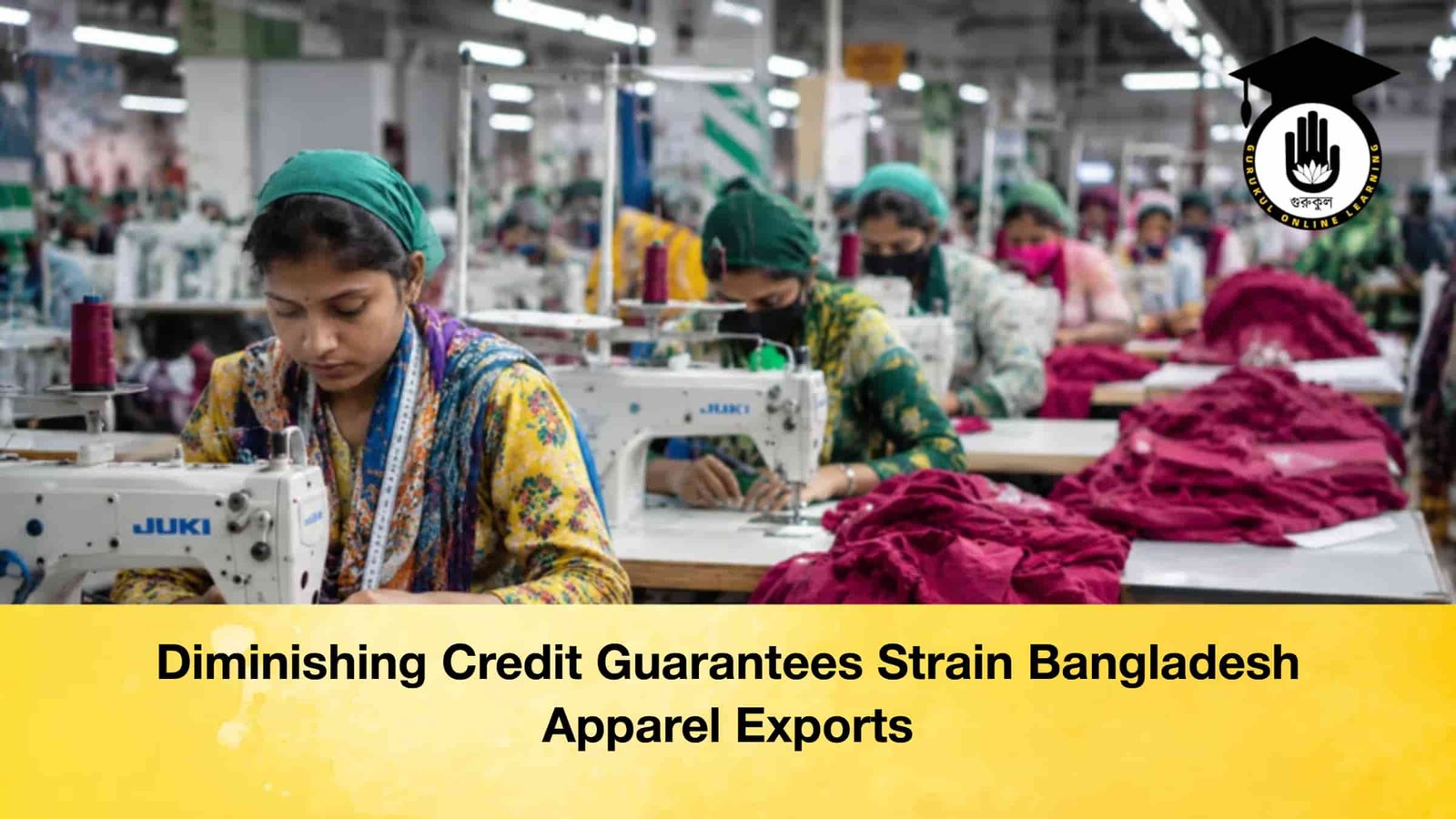
The ready-made garment (RMG) sector in Bangladesh, which serves as the backbone of the nation’s foreign exchange earnings, is currently navigating severe headwinds caused by global economic deceleration, persistent inflation, and geopolitical instability. This macroeconomic strain is further intensified by a rapid contraction in export credit guarantee insurance, a development that escalates the financial risk profile of the country’s entire export infrastructure.
Contraction in Export Revenues
Factual data compiled by the Export Promotion Bureau (EPB) and Bangladesh Bank demonstrates that ready-made garment export earnings fell by 2.82 per cent during the first ten months of the 2025–26 financial year (covering July 2025 to April 2026), dropping to $31.72 billion. Industry specialists view this downturn not as a temporary fluctuation, but as a clear indicator of declining international demand and rising trade friction. In response to these market conditions, international credit rating agencies and underwriters are systematically lowering their guarantee limits for shipments originating from Bangladesh.
Key Trade and Financial Metrics Evaluated
The specific percentage contractions across various clothing categories, international markets, and banking channels during the current fiscal year are detailed in the table below:
The Operational Value of Credit Guarantees
Export credit guarantee insurance serves as a vital safety net within the framework of international commerce. It shields domestic manufacturers from catastrophic financial loss if an international buyer defaults on payments or files for bankruptcy after the commodities have been dispatched. With secure insurance coverage in place, commercial banks routinely authorize back-to-back Letters of Credit (LCs) and pre-shipment working capital on flexible terms, allowing exporters to confidently explore non-traditional jurisdictions.
Drivers of the Guarantee Deficit
The current insurance crisis is driven by a combination of international and domestic structural problems:
-
Global Market Pressures: Elevated inflation across primary Western economies, notably the United States and the European Union, has reduced consumer purchasing power and curbed garment demand. Financial volatility among several international retailers has driven up their default risks, prompting global insurers to drastically lower their coverage exposure to avoid liabilities.
-
Domestic Energy Deficits: On the domestic front, operational capabilities have been severely compromised by infrastructural challenges. Factory owners report that acute shortages of gas and electricity have reduced RMG manufacturing capacity by 25 to 30 per cent. These persistent power deficits lead to shipment delays, making international underwriting institutions increasingly risk-averse.
Complications in Banking and Trade Modalities
The reduction in guarantee availability has forced significant changes in local trade operations. Over the July–April period, knitwear exports fell by 3.68 per cent, while woven items recorded a 1.83 per cent drop. Total exports to the European Union decreased by 4.38 per cent to $15.54 billion.
To sustain factory operations, many apparel exporters are operating under “open account” terms. This methodology places the entirety of the default risk on the exporter, vastly increasing commercial vulnerability. Similarly, exports to non-traditional markets contracted by 6.34 per cent between July and February, as businesses refuse to ship goods to unverified territories without financial insurance.
The banking sector is experiencing severe secondary effects from this trade slowdown. The opening of back-to-back import LCs dropped by 10.69 per cent between July and January. Financial executives have warned that up to one-third of all outstanding credit extended to the garment and textile sectors is now at risk of transitioning into non-performing loans (NPLs). Because of delayed export realisations and restricted guarantee insurance, commercial banks are increasingly hesitant to approve new working capital facilities, intensifying sector-wide liquidity shortages.
Policy Responses and Strategic Modernisation
Macroeconomists and trade experts argue that reversing this trend requires immediate, coordinated policy interventions. The government could establish a state-backed reinsurance framework to fill the gap left by international underwriters. Simultaneously, the state must ensure an uninterrupted supply of gas and electricity to industrial zones to stabilise factory outputs and preserve delivery timelines.
Furthermore, because of Bangladesh’s impending graduation from Least Developed Country (LDC) status, traditional export cash incentives are mandated to be phased out by July 2026. Consequently, alternative fiscal cushions, such as subsidised utility rates and improved port logistics, must be established.
Long-term survival will require a shift away from a simple reliance on Generalized System of Preferences (GSP) structures. Exporters must diversify their output, specifically targeting high-value man-made fibre (MMF) apparel. Increased capital investment in seaport and airport logistics, alongside the implementation of automated production systems, remains essential to protecting the nation’s primary export engine.