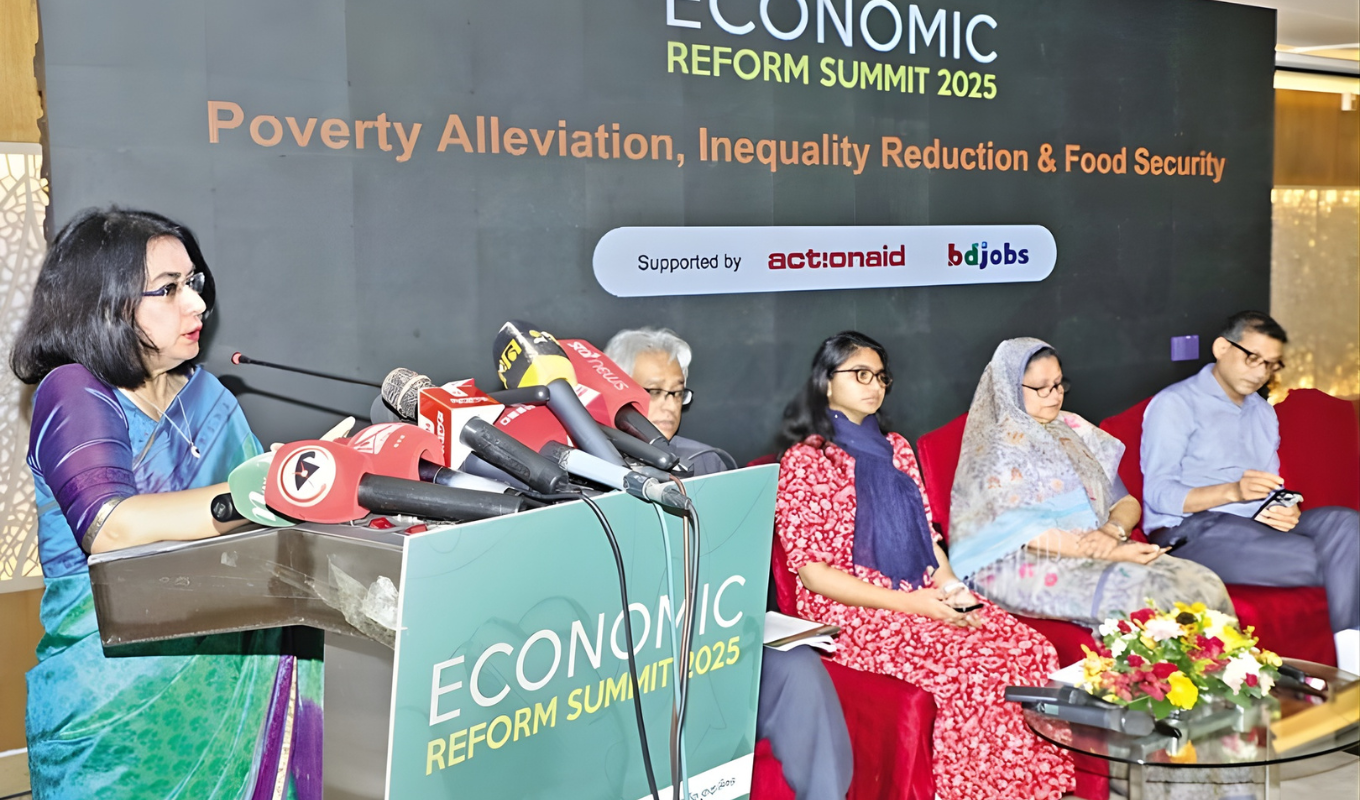
The two-day Economic Reform Summit 2025 has put forward a series of recommendations aimed at ensuring macroeconomic stability, reviving investment, and boosting job creation in Bangladesh.
The summit stressed the need for significant reforms in financial governance, trade policy, skills development, and the transformation of small and medium-sized enterprises (SMEs).
At the closing session on Tuesday, speakers emphasised that Bangladesh can no longer rely on incremental policy changes. Instead, the country must adopt a “new growth model” focused on productivity, diversification, and stronger institutions.
They pointed out that the fiscal space is narrowing due to rising interest payments and persistently low revenue mobilisation, while both public and private investment remain insufficient to meet the country’s needs. Without decisive reforms, experts warned that the economy could enter a prolonged low-growth cycle, which would erode competitiveness and hinder job creation.
A key proposal from the summit was the recapitalisation of “stressed banks” and ensuring greater regulatory independence for Bangladesh Bank to strengthen financial sector stability. The discussions also called for the rapid development of non-bank financing instruments, such as treasury and corporate bonds, mutual funds, and pension schemes, to reduce the country’s overreliance on commercial banks for long-term capital.
Further recommendations included the abolition of the 1% export tax and the simplification of customs procedures to reduce costs and time for exporters. Speakers argued that Bangladesh must prioritise foreign direct investment (FDI) in emerging sectors such as food processing, light engineering, and toys to diversify the economy beyond the ready-made garment industry.
The summit also highlighted the need to address logistics and energy constraints, particularly by modernising the country’s ports to shorten shipment times and expanding LNG imports to ensure an uninterrupted energy supply for man-made fibre-based production. Additionally, participants called for the removal of duties on solar equipment to facilitate a transition to greener, more energy-efficient industrial operations.
Youth unemployment was a central issue discussed during the summit. Speakers emphasised that addressing this challenge cannot be done through macroeconomic policy alone but requires aligning education and labour market reforms. The SME sector, which accounts for nearly 80% of employment but only 24% of GDP, was identified as a critical weak link in Bangladesh’s industrial development.
Discussions concluded with the observation that the economy is currently hampered by a large number of small, informal enterprises that struggle to grow due to limited access to credit and formal markets.