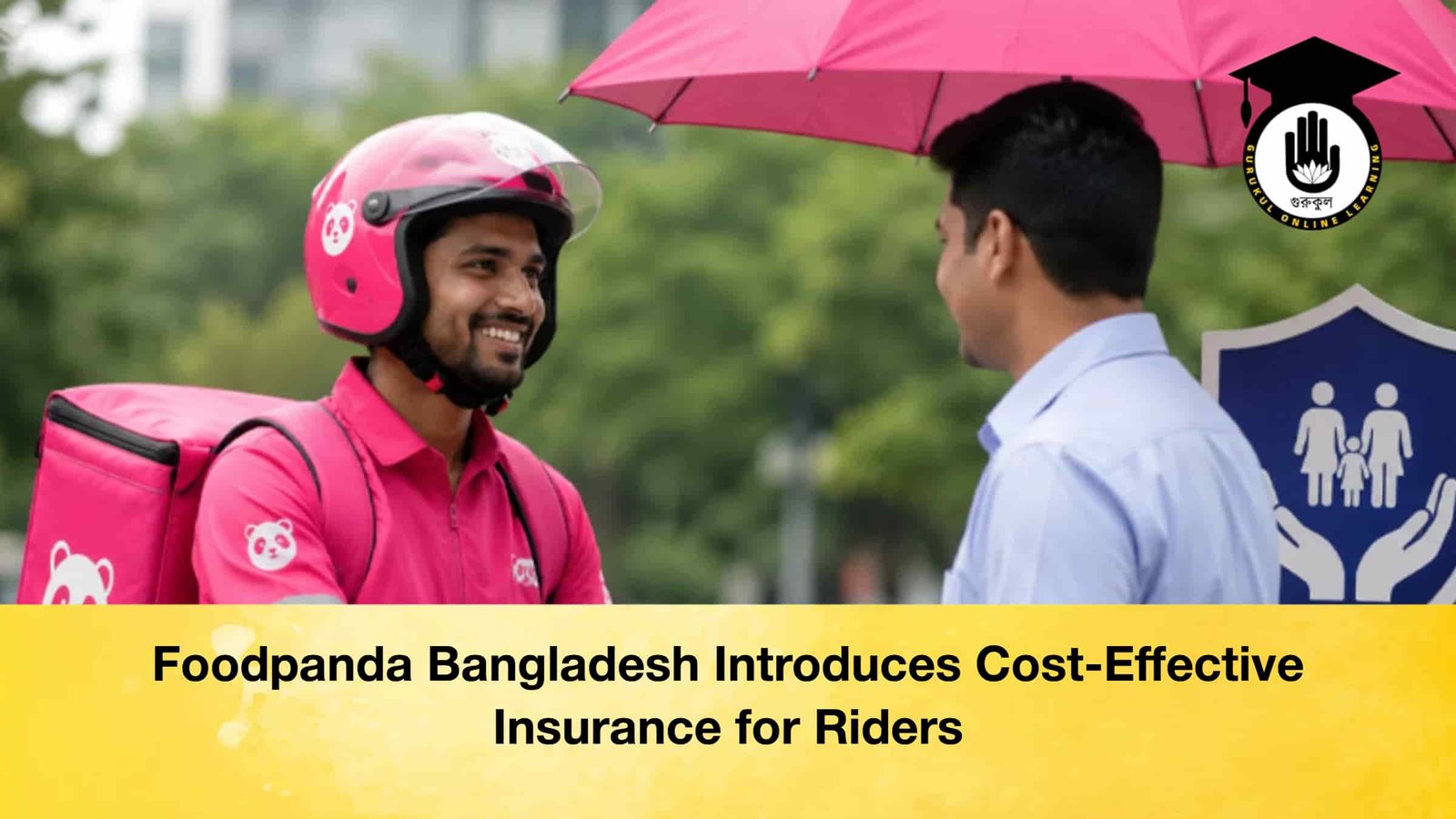
Online food and quick-commerce grocery delivery has transitioned from a urban luxury into an essential component of daily life in Bangladesh. A primary driver of this structural shift over the last decade has been Foodpanda Bangladesh, which has emerged as a major institutional employer within the country’s expanding digital gig economy.
While industry experts note that the logistics and delivery sector is experiencing rapid expansion, issues surrounding rider safety, income stability, and long-term social protection remain critical challenges. In this context, Foodpanda’s structured insurance frameworks represent a significant shift, indicating a broader evolution in the corporate management of gig-economy workforces.
Corporate History and Operational Reach
Established in Bangladesh in 2013, Foodpanda operates as a subsidiary of the Berlin-based multinational delivery platform, Delivery Hero. Following a series of global corporate restructurings, the brand currently maintains active operations across approximately 10 countries and over 400 cities throughout Asia, cementing its position as one of the largest quick-commerce networks in the region.
Initially restricted to the capital city of Dhaka, Foodpanda’s logistics network now spans all major urban centres across Bangladesh, connecting thousands of restaurants and independent commercial merchants. Independent market research indicates that Foodpanda has directly and indirectly generated over 20,000 employment opportunities nationwide, the vast majority of which comprise independent delivery riders.
Industry analysts credit Foodpanda’s market dominance to its high-density delivery network, integrated digital payment gateways, and pioneering quick-commerce execution model. Following the launch of its dedicated virtual storefront, “Pandamart,” the platform effectively diversified its inventory beyond hot meals to include daily household groceries and essential consumer commodities.
Financial Underwriting and Rider Insurance Frameworks
Despite these commercial achievements, delivery riders face substantial hazards, including prolonged exposure to traffic congestion, severe weather conditions, and high-density road risks. To address these operational vulnerabilities, Foodpanda Bangladesh has entered into strategic partnerships with domestic insurance providers to establish low-cost underwritten protection plans.
The structural specifications of these active insurance policies are detailed in the table below:
| Policy Name / Framework | Underwriting / Tech Partner | Annual Premium Cost | Maximum Coverage Limit | Coverage Conditions & Inclusions |
| Bimafy Rider Insurance | Bimafy | BDT 70 | BDT 100,000 | Applies strictly to accidental death or permanent disability sustained on duty. Excludes vehicular and personal equipment damage. |
| Panda Riders Personal Accidental Insurance | Green Delta Insurance PSC | Fully Subsidised (Free for top 1,000 riders) | BDT 100,000 | Offers BDT 100,000 for death/permanent disability; up to BDT 50,000 for partial disability. Performance-based selection. |
Operational Execution and Financial Realities
The micro-insurance initiative launched in partnership with insurtech platform Bimafy allows delivery riders to access accidental coverage via a low annual premium of BDT 70. To ensure accessibility, the claims settlement procedure has been digitized, enabling riders to submit claims directly through the delivery mobile application, dispatch management teams, or dedicated online portals. However, independent trade analysts point out that the policy does not extend coverage to physical motorbike damage or personal electronic equipment, representing an ongoing financial gap for riders.
In a separate performance-linked initiative launched in October 2025, Foodpanda partnered with Green Delta Insurance PSC to introduce the “Panda Riders Personal Accidental Insurance” scheme. Under this framework, the company fully subsidises the insurance premiums for its top-performing 1,000 riders. The policy provides BDT 100,000 in the event of death or total permanent disability, alongside a tiered payout of up to BDT 50,000 for partial physical impairment. Industry analysts view this dual-tier structure as a strategic retention mechanism that leverages corporate social protection to incentivize rider efficiency and build institutional trust.
These welfare investments are being maintained despite a challenging domestic financial environment. Multiple corporate financial filings indicate that Foodpanda Bangladesh’s cumulative operational losses had surpassed BDT 10 billion by the end of 2023. Macroeconomists state that because the local quick-commerce sector is still in a high-growth phase, heavy capital expenditure remains necessary for technological scaling and geographic expansion.
While global regulatory frameworks are increasingly compelling gig-economy platforms to formalise rider employment rights and safety mandates, Bangladesh’s legal architecture regarding digital platform workers remains in its infancy. Consequently, Foodpanda’s voluntary implementation of underwritten rider protections could serve as a foundational benchmark for future labor policy and corporate compliance within the country’s service sector.